
Jasper Projected and Actual Dates
TDCJ uses the exact label Projected Release Date. Classification and Records calculates it as the anticipated incarceration-release date if parole does not occur first. Offense date, offense class, sentence, calendar time, eligible credits, mandatory-supervision law, and Board action can affect it. The actual release date records what happened after final review and processing.
County jail status works differently. A pretrial detainee has no computed TDCJ date. Bond, dismissal, a plea, sentence credit, transfer, and outside holds can affect when the jail may release or move the person. Ask Jasper County Jail for the release reason and timestamp. If the answer is “transferred to TDCJ,” confinement continued.
- Projected release
- TDCJ’s anticipated incarceration-release date if parole does not occur sooner.
- Maximum expiration
- The sentence endpoint after the applicable calculation.
- Detainer
- A legal hold from another authority that can block community release.
- Discharge
- Formal completion of the sentence or supervision obligation.
Run a Jasper Release Lookup
The correct search depends on custody. TDCJ covers state prisoners. Jasper County Jail and the sentencing court cover county detention. A no-result in one system does not prove release from another.
- Confirm whether the person stayed in Jasper County Jail or entered TDCJ custody. Use the Sheriff release reason and receiving agency.
- For TDCJ custody, open the official offender search. Search by TDCJ or SID number when known, or use the available name fields.
- Read “Projected Release Date” beside the current sentence data. Also note maximum expiration and parole information.
- If the result is absent or unclear, use the TDCJ email information route with full name and identifiers.
- For a county sentence, request the jail time-computation sheet or release record and compare it with the signed judgment.
- After the projected day, request the actual release or discharge record and check for a transfer or hold.
The Jasper County released-inmate search gives the broader trail for someone who has left the county roster.
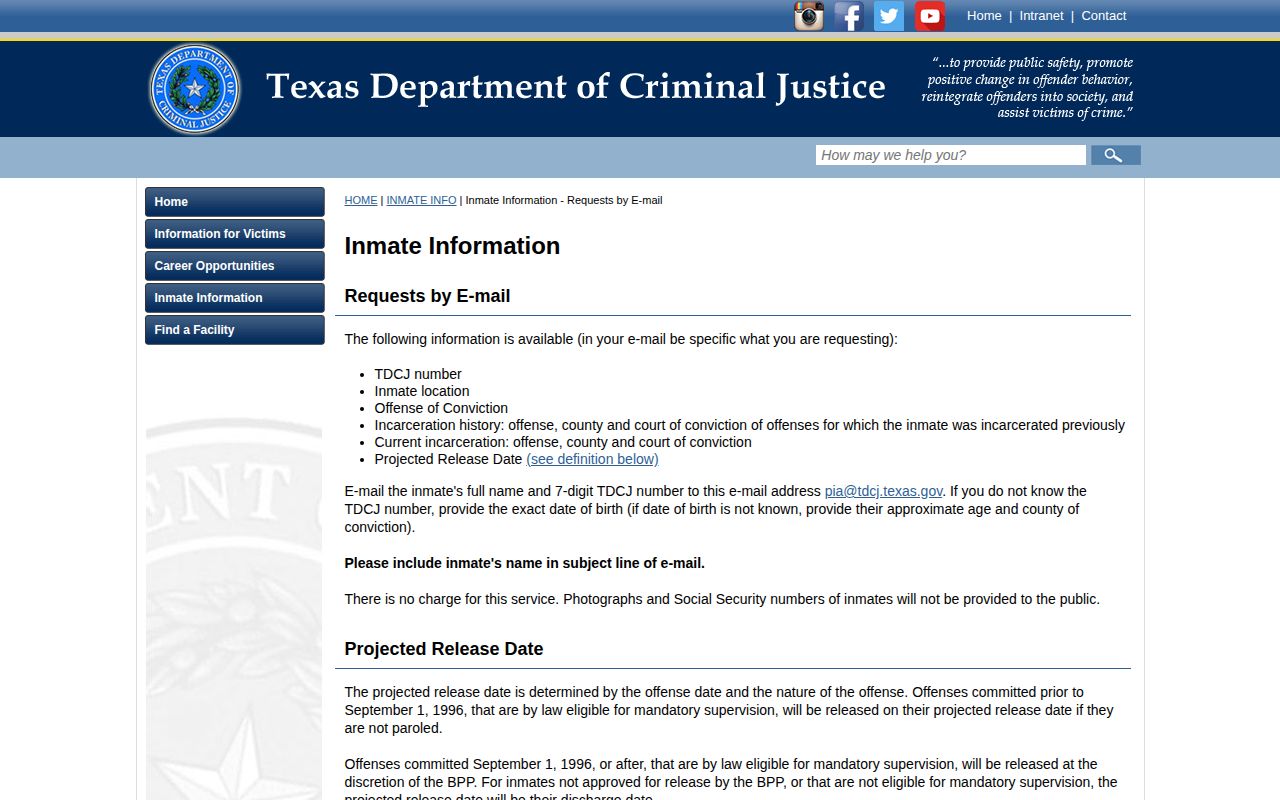
The TDCJ information page explains the request channel for projected-date and incarceration data.
Texas Release Date Calculation
Texas good-conduct time does not erase part of a sentence. Government Code §498.005 says credit applies to eligibility for parole or mandatory supervision and does not otherwise reduce the sentence. Credits can be forfeited under §498.004. Saying someone “earned days off” can therefore misstate the law.
For eligible offenses committed before September 1, 1996, calendar time plus accrued good time may reach the term for mandatory supervision. For eligible later offenses, the Board may deny discretionary mandatory supervision under statutory findings. Noneligible offenses can project to maximum expiration. The offense date and controlling law matter.
General parole eligibility under §508.145 often uses calendar time plus good time equal to one-fourth of the sentence or 15 years, whichever is less. Special categories can require one-half of the sentence or 30 years in actual calendar time. Eligibility opens review. It does not promise release.
Why Jasper Release Dates Change
TDCJ recalculates when facts or governing status change. Never use a saved result as permanent proof. Record the capture date, URL, exact field label, and identifiers, then check again near the expected event.
| Change | Possible effect | Confirm with |
|---|---|---|
| Disciplinary forfeiture | Eligible good time may be lost | TDCJ Classification and Records |
| Sentence correction | Time calculation moves | Court order and TDCJ audit |
| New detainer | Community release may be blocked | Holding and receiving agencies |
| Board decision | Parole path changes | BPP and TDCJ status |
| Record update | Projected dates recalculate | Current official record |
A passed date is a prompt to investigate, not proof of release. Ask whether the Board denied discretionary mandatory supervision, a credit changed, or another authority placed a hold.
Confirm Jasper’s Actual Release
Use the custodian’s event record. Jasper Jail/Records confirms county booking, release time, reason, and transfer destination. TDCJ confirms state release, parole, mandatory supervision, or discharge. A court judgment explains the case but does not prove the minute someone cleared the jail door.
Texas now uses IVSS-Counties for county alerts. The VINE Inmate Check explains that transition. Alerts may report release or transfer, but they are not certified records. If an alert says transfer to TDCJ, ICE, USMS, or another county, continue with that receiving system.
TDCJ Classification and Records can be reached at 936-437-6231 or classify@tdcj.texas.gov. The email route has no fee for its listed fields. Those contacts cover state incarceration, not a county-jail-only case.
No General Texas 85 Percent Rule
Texas has no general rule requiring every state prisoner to serve about 85 percent of a sentence. That number is often imported from other contexts and can produce a false date. Texas relies on offense-specific statutes, calendar time, eligible credits, parole rules, and mandatory-supervision exclusions.
Do not use a generic calculator. Determine the offense date and conviction provision, then read Chapters 498 and 508 with the official TDCJ calculation. Section 508.149 lists mandatory-supervision exclusions. A Board decision can also affect eligible post-1996 cases.
Jasper County Jail Time Computation
No official Jasper County jail good-time formula, weekend-release policy, or public release-hour rule was found in the sources reviewed on August 2, 2026. Do not apply TDCJ formulas to a county sentence. The judgment, jail credit, and any authorized local credit must be read through the jail’s calculation.
Request an existing time-computation sheet, release record, and relevant judgment. Ask for admission and release timestamps, release reason, and receiving agency. If the Sheriff has not published a fee, confirm the charge before ordering under the Texas Public Information Act.
Jasper Release Date Fields
Read the label before copying a date. TDCJ records can contain several milestones that look alike but carry different meanings. A release record should preserve the source, field name, and date as displayed. If the public result omits the needed history, request the existing data through TDCJ rather than calculating it from a sentence length.
| Field | Meaning |
|---|---|
| Projected Release Date | Anticipated incarceration release if parole does not occur sooner |
| Maximum Expiration Date | Calculated sentence endpoint |
| Parole eligibility | Earliest review possibility, not an exit date |
| Actual release date | Recorded event after processing |
| Release type | Parole, mandatory supervision, discharge, or transfer context |
TDCJ online and email information can include name, identifiers, location for current inmates, conviction offense and county, sentence data, and a projected date for current incarceration. A no-result can reflect search input, scope, or archive behavior. It does not affirmatively prove release. Use full identity and a TDCJ or SID number when available.
For a county record, ask for admission date and time, release date and time, release reason, receiving agency, charges, bond information when applicable, and booking number. Those fields distinguish return to the community from a transfer. The Sheriff’s record and TDCJ record should be kept as separate legs of the custody history.
Jasper Parole Dates Need Context
A “parole date” may refer to eligibility, a Board vote, a planned release, or an actual TDCJ release. These milestones are not interchangeable. Texas does not hold a formal public hearing for ordinary parole consideration. Board members review the file and vote in sequence, and two matching votes on a three-member panel decide the result. A denial can set a later review date. An approval may carry programs or conditions and can still face release processing or reconsideration.
Individual information is available through the TDCJ search and the BPP status route. The status line is 844-512-0461 during published weekday business hours. Use the person’s name, TDCJ number, and birth date as needed to distinguish the record. A result may show that review is underway, the last decision and date, or the next review. Copy the Texas vote code as shown instead of reducing it to a generic label.
BPP administrative meeting and workshop minutes do not form an inmate release calendar. They document agency meetings, not person-by-person parole votes. A favorable decision must still be paired with TDCJ processing and the actual event record. This sequence explains why an eligibility date or Board action can appear before the date a person physically leaves state custody.
Mandatory supervision also needs its own label. It is not parole, although both can involve community supervision through TDCJ. Section 508.149 exclusions and Board findings can alter the projected path. When a result is unclear, ask Classification and Records for the current calculation and ask BPP about the decision status. Keep both responses with the final release record.
Public Record Search
Sponsored Results